A Story That Would Have Been Impossible 18 Months Ago
A few weeks ago we watched a Series B founder do something that would have been impossible just eighteen months ago.
She had a list of 4,200 target accounts. By Friday afternoon she needed:
- Personalized outbound landing pages for the top 200
- Each page scored by intent signals from six different sources
- Custom email sequences referencing each prospect's recent product launches, hiring patterns, and stated strategic priorities
- Pages hosted on her domain
- Everything tracked end-to-end into Salesforce
- AE routing based on territory and account fit
Her marketing team (three people including a contracted demand gen lead) said it would take six weeks. They needed a developer, a designer, a copywriter, and an external agency for the data enrichment work.
She ignored them and called one person instead.
By Monday morning the system was live. Two hundred dynamically generated landing pages. A sequenced outreach engine that adapted its messaging based on which page sections each prospect engaged with. A scoring model that decayed dead leads and elevated active ones. A Slack notification firing whenever a target account took three or more high-intent actions in a 48-hour window.
The person she called wasn't a CMO. Wasn't a CGO. Wasn't a Fractional CMO. Wasn't a growth marketer. Wasn't an agency. Was technically only one person, though the systems she shipped did the work of about fifteen.
She was a GTM Engineer.
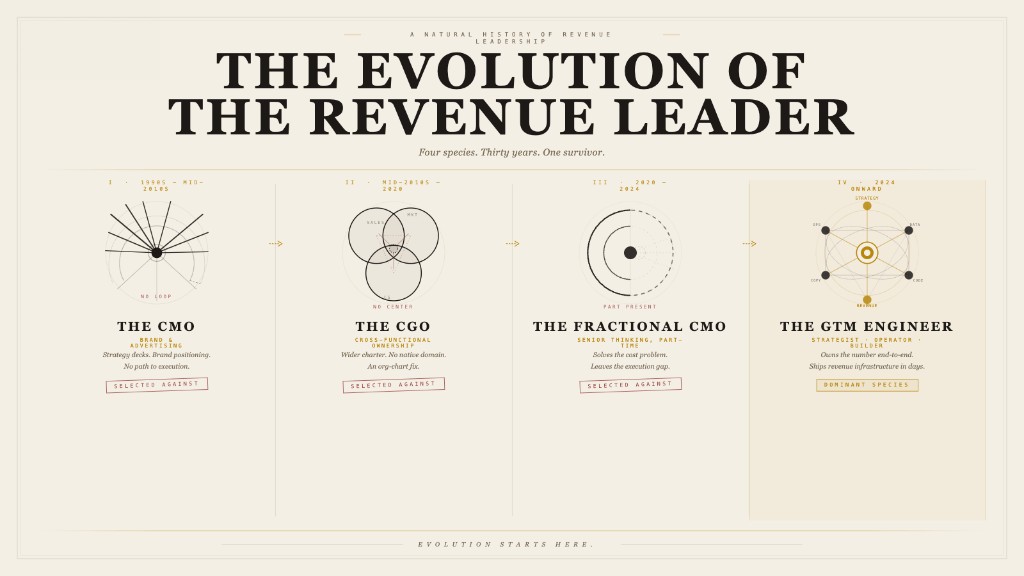
The reason this story matters is not that one role replaced another. It's that this is the fourth time in roughly thirty years that the dominant species of revenue leader has been replaced. Each one was selected for by the conditions of its era. Each one survived as long as those conditions held. Each one gave way when the environment shifted.
We've spent the last decade inside this evolution, across more than a hundred sales leadership engagements with founders in Silicon Valley and around the world. We've staffed CMOs. We've staffed CGOs. We've staffed Fractional CMOs. And right now, we are watching a fourth species emerge that is changing the math of go-to-market in ways most operators have not yet absorbed.
This essay is about that evolution. The four species. The selection pressures that killed each one. The forces that produced the next. And the reason any company in growth mode that doesn't recognize this pattern is, in the most literal Darwinian sense, about to be selected against.
The Four Species, in Order
| Era | Species | Selected for | Selected against by |
|---|---|---|---|
| 1990s to mid-2010s | The CMO | Brand, positioning, advertising | Digital fragmentation |
| Mid-2010s to 2020 | The CGO | Cross-functional revenue ownership | Org politics and unclear charter |
| 2020 to 2024 | The Fractional CMO | Senior pattern recognition at lower cost | The execution gap |
| 2024 onward | The GTM Engineer | Strategy plus building plus AI workforce | Nothing yet |
We'll walk through each in turn. Then we'll explain why the fourth species is structurally different, and why this round of evolution is not just another swing of the pendulum.
Species One: The CMO (1990s to mid-2010s)
The Habitat
The Chief Marketing Officer evolved in an environment defined by a relatively bounded set of channels. Television. Print. Outdoor. Trade shows. Direct mail. Early digital, then later digital. The job was to own the brand, allocate the media budget, hire the agency, and manage a team of specialists who each owned a discrete sub-discipline.
In this habitat the CMO was perfectly adapted. Brand was the moat. Positioning was the weapon. Creative was the differentiator. Sales lived in a parallel hierarchy and the two functions met at the trade show booth and at the quarterly reporting meeting.
The Apex
For roughly two decades this species dominated. The Procter and Gamble brand managers grew up to become the CMOs of every other category. The hierarchy was clean. The metrics were soft enough to defend. The role carried genuine weight in the C-suite.
The Selection Pressure
Then digital happened, and digital kept happening. The marketing function had to absorb, in roughly chronological order:
- Search marketing
- Display advertising
- SEO
- Content marketing
- Social media as marketing
- Email automation
- Marketing operations
- Attribution analytics
- Paid search and paid social as separate disciplines
- Conversion rate optimization
- Product marketing as its own function
- Growth marketing as another distinct function
- Lifecycle marketing
- Community
- Events as a strategic channel
- Partnerships
- Influencer programs
- Podcasts and creator economies
- ABM as a sub-discipline
- RevOps as either a part of or distinct from marketing ops, depending on the org
By 2019 the modern CMO was supposed to credibly oversee something like fifteen distinct sub-disciplines, each with its own tools, its own metrics, its own vocabulary, and its own emergent best practices that changed every six months.
The species could not adapt fast enough.
The Symptom
The most-cited fact about the CMO role is also the most damning. Average CMO tenure has been hovering between 18 and 28 months for years. Some industry data has it dipping below 18.
Compare this to other C-suite roles:
- CFOs typically last five years or more
- CTOs hold their seats for four to six years
- COOs often longer than that
This is not because CMOs are uniquely incompetent. It is because the role was never designed for the environment it now operates in. The classical CMO is a strategist and a manager. They set positioning, allocate budget, hire and develop talent, manage agencies, report to the CEO and the board, bridge marketing to sales, and maintain the brand.
What the classical CMO is not is a builder. The classical CMO does not personally ship campaigns. Does not personally write SQL against the warehouse. Does not personally configure HubSpot workflows. Does not personally code Clay tables, build n8n graphs, or stand up custom AI agents.
In a world where execution velocity determines survival, and where the tools of execution have become so technical that competence requires actual technical skill, having your senior marketing leader live three layers of abstraction away from the actual work is an unforgivable liability.
The species was selected against. Not all at once, but in the aggregate. The board hires a CMO to make growth happen. They produce strategy decks. The team underneath them executes against those decks slowly and imperfectly. The numbers don't move. Replacement.
This pattern has now repeated tens of thousands of times across the industry, and it produced the conditions for the next species.
Species Two: The CGO (mid-2010s to 2020)
The Habitat
By the mid-2010s, founders and boards had clearly noticed the CMO problem. The most thoughtful response was the elevation of a new title: Chief Growth Officer.
The CGO was an attempt to solve the structural defect of the CMO by widening the charter. Where the CMO owned only marketing, the CGO would own everything that touched revenue:
- Marketing
- Sales operations
- Customer success in the expansion sense
- Sometimes product growth
- Sometimes RevOps
- Always the funnel as a single object
The thesis was elegant. If marketing alone is too narrow a charter to reliably move the number, then expand the charter. Put one person in charge of the entire growth motion. Tie compensation to revenue, not to leads. Break the hand-off between marketing and sales.
Companies like HubSpot, Intercom, Coca-Cola, and Mastercard installed CGOs. The title appeared in venture-backed startups across the Bay Area. For a moment, it looked like this might be the new dominant species.
The Selection Pressure
The CGO was an org-chart fix, not a structural fix. And org-chart fixes have a poor evolutionary record.
Three pressures killed the role at most companies:
One: Political instability. The CGO sat awkwardly between the CMO and the CRO (or VP of Sales). When all three roles existed, charter was unclear and politics dominated. When the CGO was meant to absorb both, the resulting role was so broad that no single human could credibly hold it.
Two: No native domain. The CMO has brand and advertising. The CRO has the deal cycle. The CGO had a Venn diagram. When pressure rose, the Venn diagram got carved up between the people who owned the actual functions.
Three: Person-dependent. The CGOs that worked tended to work because of one extraordinary individual. When that individual left, the role was usually retired and the functions snapped back to a CMO and CRO split.
By 2020 the CGO was already in decline at most growth-stage companies. The title still exists at some larger enterprises and in pockets of the portfolio companies we work with, but the species never achieved dominance.
The Lesson
The CGO's failure taught the market something important: combining functions under one title is not the same as combining capabilities in one person. You cannot solve a structural problem with a job posting.
The next two species would each, in their own way, attempt a real structural fix instead of an organizational one.
Species Three: The Fractional CMO (2020 to 2024)
The Habitat
The early 2020s produced a new environment. The pandemic forced remote work. Capital markets compressed after 2022. ZIRP-era marketing budgets evaporated. Series A and Series B companies that had been able to afford a six-figure full-time CMO suddenly couldn't, or shouldn't.
Into this environment evolved the Fractional CMO.
The pitch was elegant:
- You're a Series A or early Series B company.
- You don't have the budget for a full-time CMO.
- You don't actually need someone in the building forty hours a week.
- What you need is senior strategic thinking for ten to fifteen hours per month, at a fraction of the cost.
For a moment this worked. Companies got senior thinking they couldn't otherwise afford. Veteran marketers got portable income and interesting variety. A whole ecosystem of fractional executive marketplaces, communities, and certifications emerged.
We have placed dozens of Fractional CMOs and CROs into our portfolio companies over the last several years. The role is real and it solves a real problem.
The Selection Pressure
The Fractional CMO solves the cost problem. It does not solve the structural problem.
The Fractional CMO is the same species as the full-time CMO, just compressed into fewer hours. They are strategists. They produce frameworks, positioning documents, ICP exercises, GTM plans, and sales-and-marketing alignment workshops. All of this has real value when the company underneath them can execute.
The pattern, repeated:
- Fractional CMO produces strategy.
- Strategy needs execution.
- Fractional CMO does not execute.
- Junior in-house team or agency translates the strategy into work.
- Translation is lossy.
- Work ships slowly.
- Results lag.
- Fractional CMO churns at the end of the engagement, taking institutional context with them.
- They leave behind a folder of slide decks and a Notion workspace nobody updates.
The good Fractional CMO engagements produce real strategic clarity that the company desperately needed. The bad ones produce expensive corporate astrology. Almost none of them produce what every growth-stage company actually needs: compounding execution capacity. The systems, automations, and infrastructure that keep generating revenue after the engagement ends.
Why This Species Was Always Transitional
The Fractional CMO was an adaptation to capital constraint, not an adaptation to the underlying environment. The actual environment, by 2023, had changed in ways that made strategy without execution increasingly insufficient.
Three shifts were already underway:
- AI was eliminating the labor floor of marketing work. Tasks that used to take a team of five now took an hour, if you knew how to prompt the system.
- The GTM stack was becoming composable. Clay, n8n, Hightouch, Cursor, and a dozen other tools were collapsing the gap between strategy and shipped infrastructure.
- A new generation of operators was emerging who treated the line between marketing tools and engineering tools as imaginary.
The Fractional CMO species could not absorb these shifts because their core proposition was time, not capability. They sold strategic hours. They could not sell shipped systems, because they could not personally ship them.
A new species was already adapting to the new environment.
Species Four: The GTM Engineer (2024 onward)
The Habitat
The environment that produced the GTM Engineer is genuinely new. Four forces converged in a narrow window of time, and together they made a kind of operator possible that simply could not have existed five years ago.
Force one: AI eliminated the labor floor of marketing work.
Every task in marketing used to have a labor floor:
- Writing fifty cold emails took five hours of a copywriter's day
- Generating two hundred ICP-matched company profiles took an SDR a week
- Creating a thousand-page programmatic SEO site required three writers and a project manager working for two months
- Building a personalized landing page per target account meant a designer, a copywriter, and a developer triangulating for a sprint
The labor floor is now zero, or close enough to zero that the difference is rounding error. A capable operator with a well-constructed prompt chain and some Clay tables can produce all of the above before lunch.
The constraint is no longer human-hours. The constraint is taste, judgment, and systems design. This is exactly the constraint that suits a single high-leverage operator and exactly the constraint that disadvantages a sprawling team. Teams optimize labor allocation. There's no labor to allocate anymore. The bottleneck moved upstream into design and judgment, where one excellent mind beats a committee every time.
Force two: The composable GTM stack matured.
Around 2022 to 2024, a new generation of tools quietly transformed the GTM operating environment:
- Clay made data enrichment programmable through a spreadsheet interface
- n8n and Make made workflow orchestration accessible to non-developers
- Hightouch and Census made the data warehouse usable as a source of truth for activation
- Cursor, Replit, and Lovable made bespoke internal tools and landing pages buildable in hours instead of weeks
- Apollo, Smartlead, and Instantly made multichannel outbound at scale a configuration problem rather than a development project
- AI-native CRMs like Attio and Folk offered escape hatches from Salesforce gravity for companies willing to take them
The modern GTM stack is now composable in the way that Lego is composable. A capable operator can stand up systems in days that would have taken a small engineering team months.
Force three: Data infrastructure became consumer-grade.
Snowflake, BigQuery, dbt, reverse ETL, open-source event tracking, identity resolution. The data stack that used to require a team of data engineers can now be operated by a single technical operator. For the first time in history, one person can plausibly own the entire revenue data loop:
- Ingest product usage events
- Enrich with firmographic data
- Score through a custom model
- Sync the scores back to the CRM
- Trigger sequences based on the scores
- Measure conversion
- Feed results back into the model
All without ever waiting on a data team.
Force four: A new generation of operators showed up.
This is the most underappreciated shift, and it is the one we've watched most closely from inside our network.
There's a new generation of operators in their late twenties and thirties who came up natively in the SaaS, growth, and creator economies, and who learned to code somewhere along the way. Sometimes they were engineers who got pulled into commercial roles because they could ship. Sometimes they were marketers who learned Python because Excel kept letting them down. Sometimes they were ex-founders whose first startup taught them every function. Sometimes they were product managers who got tired of waiting for resources.
The common thread: they treat the line between "marketing tools" and "engineering tools" as imaginary. They don't experience HubSpot and Postman as different categories. They don't think of Clay as a marketing tool and n8n as an engineering tool. They're both just tools that move data around to produce business outcomes.
When you take this kind of operator and put them in front of the modern GTM stack, with AI as a labor multiplier, you get the GTM Engineer.
The Definition
The GTM Engineer is a single high-leverage operator who owns go-to-market as a system: combining the strategic responsibilities of a head of marketing, the operational rigor of a RevOps lead, and the building capacity of a software engineer, with AI agents as their primary workforce and the composable GTM stack as their building blocks.
Three pieces:
- Strategist
- Operator
- Engineer
The combination matters:
- A strategist who can't build is slow
- An engineer who doesn't own the strategy builds the wrong thing
- An operator without engineering depth hits a ceiling within months because the work that creates real leverage is increasingly technical
Combine all three and you get something genuinely new. An operator who can decide what should exist, build it personally inside of a week, run it, measure it, iterate on it, and own the revenue impact end-to-end.
That last part is the punchline. A GTM Engineer owns the revenue impact end-to-end. Not "owns the strategy." Not "manages a team that owns the impact." Personally accountable for the number, with the technical capability to actually move it.
What the GTM Engineer Actually Builds
Abstract definitions only get you so far. Here's a partial inventory of the kinds of systems we've watched a competent GTM Engineer ship in their first six months at a growth-stage company.
Outbound and Prospecting Infrastructure
A signal-driven prospecting system that:
- Monitors hiring patterns, technology stack changes, funding announcements, leadership moves, podcast appearances, and conference attendance across thousands of target accounts
- Weights each signal and scores accounts
- Flows the top of the list into Clay for enrichment
- Generates personalized email and LinkedIn sequences via an AI pipeline
- Fires sequences through whichever channel each prospect is most likely to respond to
- Runs without human intervention except for monitoring quality
This used to be a team of four to six people. The GTM Engineer does it in code and configurations.
Programmatic SEO and Content Systems
A pipeline that identifies high-intent long-tail keywords, generates structured data for each, produces a unique landing page per keyword via templated AI generation with quality gates, publishes to a headless CMS, monitors rankings, prunes underperformers, and reinvests budget into winners.
Sites that would have taken twelve months and a content team of five to build now go live in three weeks.
Personalization and Account-Based GTM at Scale
- Per-account microsites
- Custom video pitches generated programmatically
- Dynamic LinkedIn ads tailored to each individual decision-maker at a target company
- Follow-up plays that reference specific actions a prospect took on the site
Real one-to-one ABM, which the industry has been promising for a decade and almost no one has ever delivered, becomes actually feasible.
Lifecycle and Product-Led Growth Instrumentation
- Behavioral event tracking integrated cleanly between product, CRM, and marketing automation
- Activation milestones defined, instrumented, and used to drive contextual outreach
- Churn risk models that watch usage decay and trigger interventions
- Expansion plays tied to feature adoption
Custom Attribution and Revenue Analytics
- Multi-touch attribution against actual revenue, not vanity metrics
- Custom models that account for the messy reality of B2B buying
- Pipeline health dashboards that show leadership exactly where the funnel is leaking and why
- Forecasting models that beat the rep-by-rep rollup
Integration Glue
The unsexy but essential work of wiring every system to every other system. CRM to product. Product to data warehouse. Warehouse to activation. Activation back to CRM. Clean identity resolution. Reliable webhooks. Backfills when things break.
Internal Operator Tools
- Custom dashboards for the sales team showing exactly which accounts to prioritize and why
- Internal playbook engines that walk reps through the next best action for each opportunity
- AI assistants that draft follow-up emails based on call transcripts
- Lightweight CRMs built from scratch when the heavyweight one is too expensive or too inflexible
AI-Native Sales Support
- Systems that listen to discovery calls, extract structured data, push it into the CRM, generate follow-up emails, and schedule next steps
- Agents that handle inbound questions on the website at the level of a competent SDR
- Tooling that lets reps spend their time on the highest-value part of the conversation
The Cumulative Effect
After a year of work by one of these operators, the company's go-to-market motion looks like a software product. Humming along. Generating compounding outputs. Each new piece making the existing pieces better.
This is the opposite of the marketing department of a decade ago, which looked like a series of one-off campaigns that produced spikes and then went dormant.
Compounding versus episodic. That's the difference. A GTM Engineer builds compounding revenue infrastructure. A marketing team mostly runs episodic campaigns. In growth mode, compounding wins by an absurd margin.
This is exactly what every growth-stage company should be building: repeatable, scalable revenue systems that produce predictable outcomes and improve with every iteration.
The Leverage Math
Let's put numbers on it, because the economics are the part of the argument that should make every founder and operator stop and recalculate.
The Traditional Marketing Team
A traditional growth-stage marketing team at a Series B SaaS company:
| Role | All-in Annual Cost |
|---|---|
| VP of Marketing | $300K to $400K |
| Demand Generation Lead | $180K |
| Content Lead | $150K |
| Demand Gen Specialists (x2) | $240K |
| Content Writers (x2) | $180K |
| Marketing Operations | $160K |
| Designer | $120K |
| Agency spend | $300K |
| Tooling | $200K |
| Total | ~$2,000,000 |
Eight to ten people, plus contractors. Each person responsible for a slice of the function. Hand-offs at every boundary. Decisions made in meetings. Work shipped on a sprint cadence at best.
The GTM Engineer Pod
| Role | All-in Annual Cost |
|---|---|
| Senior GTM Engineer | $300K to $400K |
| Junior GTM Engineer | $180K to $250K |
| AI tools and GTM stack | $100K |
| Selective contractors | $100K |
| Total | ~$700K to $900K |
Two people. Decisions made by the people doing the work. Shipping cadence measured in days, not sprints.
Why the Cost Savings Aren't the Point
The naive read is that this saves about a million dollars a year. That's not the actual point.
The actual point is velocity.
In a growth-stage company, the difference between a six-week shipping cycle and a six-day shipping cycle is more important than the difference between two million dollars of marketing spend and one million dollars of marketing spend.
Speed compounds:
- Every week you're not shipping is a week your competitors might be
- Every iteration you complete is one more shot at finding the loop that actually works
Why Traditional Teams Ship Slowly
Watch the typical chain of events:
- Strategist briefs the operator
- Operator briefs the writer
- Writer drafts
- Brief comes back wrong
- Operator clarifies
- Writer revises
- Strategist reviews
- Agency gets involved
- Agency takes two weeks
- Result needs technical work
- Engineering team has other priorities
- Launch slips
- Launch finally happens
- Attribution doesn't work because nobody set it up
- Three weeks later you find out the test was inconclusive
Each hand-off is an opportunity for entropy.
The GTM Engineer eliminates the hand-offs. They are the strategist, operator, writer, and engineer in one person, so the work flows through a single skull at the speed of thought.
In practice it's five to ten times faster shipping cadence. Sometimes more.
Why Each Previous Species Cannot Compete
Let's be direct about why the GTM Engineer beats every prior species head to head, in the environment we're now in.
The CMO Cannot Compete
The CMO operates at a strategic altitude that requires translation through a team. In the current environment, translation is the bottleneck, not strategy. The CMO's competitive disadvantage is that they cannot personally ship at the velocity the environment now demands, and the team beneath them adds latency rather than removing it.
The CGO Cannot Compete
The CGO was already an organizational compromise. In the current environment, organizational compromises that don't change underlying capability are even less viable than they were a decade ago. The CGO has the same translation problem as the CMO, just spread across more functions.
The Fractional CMO Cannot Compete
The Fractional CMO solves a cost problem at the price of an execution problem. In the current environment, where execution velocity determines whether a growth loop ever reaches escape velocity, this trade-off has become structurally bad. A Fractional CMO who could code would be a GTM Engineer. The fact that they cannot code is what makes them a Fractional CMO.
The Strategic Implication
These advantages are not small. They're structural.
Once a company in your space hires a real GTM Engineer, your traditional ten-person marketing team is no longer just a more expensive way of doing things. It's a slower way, a less effective way, and a strategically disadvantaged way.
The math doesn't tilt in your favor over time. It tilts further against you.
This is what evolution actually looks like in real time. Not a slow drift. A fast and irreversible reordering of which species can survive in the new environment.
The Profile of a Great GTM Engineer
This species is rare. Knowing what to look for is half the battle.
Technical Skills (Roughly in Order of Importance)
- Comfortable writing Python and JavaScript well enough to prototype solutions
- Fluent in SQL against a real warehouse
- Deep familiarity with REST APIs, webhooks, and the daily reality of integrating third-party systems
- Skilled at prompt engineering and the construction of multi-step LLM pipelines
- Familiar with at least one orchestration platform such as n8n, Make, Zapier at the high end, or one of the AI-agent platforms emerging right now
- Comfortable enough with web technology to ship a landing page or internal tool without waiting on a frontend engineer
- Familiarity with CDPs, reverse ETL, and event tracking
- Hands-on experience with the modern outbound stack: Clay especially, plus Apollo, Smartlead, Instantly, or whatever comes next
You don't need them to be a senior software engineer. You need them to be technical enough that "let me build that" is a credible response to almost any GTM problem.
Commercial Skills (Equally Important and Often Underweighted)
- Genuine instinct for ICP and positioning
- Ability to read a sales motion and identify where it's leaking
- Understanding of how B2B buying actually works (multiple stakeholders, political dynamics, long cycles, importance of timing)
- Skill at writing copy that converts
- Pattern recognition across categories
- The ability to walk into a company and within two weeks have an opinionated point of view on what should change and why
This is the part most engineers can't fake. Pure technical talent without commercial instincts produces beautifully built systems that solve the wrong problems.
Mindset and Disposition
- Heavy bias toward shipping
- Comfort with ambiguity, since most of the work involves figuring out what the right thing to build even is
- Willingness to throw away work when it's not working, instead of defending sunk costs
- Curiosity about every adjacent discipline (sales, product, design, engineering)
- A founder mentality, in the sense of treating the company's revenue problem as their own personal problem
You're looking for someone who could plausibly start their own company, has perhaps done so before or thought seriously about it, and has chosen to apply that energy inside someone else's company because the leverage is better.
Where They Come From
- Ex-founders whose first or second company taught them every function
- Engineers who got pulled into commercial roles at growth-stage startups and discovered they liked it
- Product managers at growth-led companies who learned to ship without engineering support
- Senior growth marketers who taught themselves to code over the past three years
- Operators from the consulting and agency world who got tired of advising and wanted to build
- Solo creators or indie hackers who discovered they could make more impact inside a company
You will rarely find these people on traditional job boards. They're more likely to be visible through their work: open-source contributions, write-ups on what they've built, social presences where they share systems, podcast appearances where they explain how they think.
Finding them is hard. Recognizing them when you see them is harder. Closing them at the right comp is hardest of all. They know what they're worth.
How to Hire One
Hiring a GTM Engineer is unlike hiring a traditional marketing leader.
You're not screening for years of experience at name-brand companies. You're not running a structured interview process built around behavioral questions. You're looking for a builder. The way to evaluate a builder is to look at what they've built.
Step One: Portfolio Over Resume
Ask candidates to walk you through three to five systems they've built end-to-end. Not campaigns. Not strategies. Systems.
Look for: the architecture, the choices, the trade-offs, the outcomes.
A great candidate talks about this work with the specificity and energy that only comes from having actually done it. A weak candidate speaks in generalities and quickly retreats into management language.
Step Two: Technical Depth Check
Have them walk through how they would build a specific thing. Pick something realistic from your own GTM motion, like a signal-based account prioritization system that flows into a personalized outbound sequence.
Watch how they think:
- Do they immediately start sketching the data flow?
- Do they ask the right clarifying questions?
- Do they know which tools they'd use and why?
- Do they have an opinion about build versus buy at each layer?
Step Three: Commercial Instinct Check
Have them critique your current GTM motion. Give them access to a sanitized version of your funnel data, your ICP definition, your current outbound and inbound playbooks.
Ask for an honest assessment in writing within a week. The quality of their critique tells you almost everything about whether their strategic instincts match their technical skills.
Step Four: Trial Project
Pay them well for a small bounded engagement (two to four weeks) to ship one real system.
Watch what they do:
- Do they overscope?
- Do they ship?
- Does the work hold up?
- Do they communicate well?
- Does the system actually move a number?
This single artifact is worth more than ten reference checks.
Step Five: Founder Fit
A GTM Engineer is going to be one of your most senior individual contributors and is going to work very closely with the founder or CEO. The relationship has to work.
They need to be able to push back, take direction without ego, run with autonomy, and report up clearly. Spend real time on this fit.
A Note on Compensation
These people are senior. They deserve and expect senior compensation:
- Cash: $300K to $450K is reasonable for a strong senior hire in major US markets
- Equity: Commensurate with a senior leadership role, often founding-team-level for the first GTM Engineer in a company
Underpaying these people to anchor on traditional marketing comp bands is a classic mistake. They will leave, often to start their own company.
The First Ninety Days
Once you hire one, what does the ramp look like?
Days 1 to 15: Audit and Orient
Don't ask them to ship yet. Ask them to learn:
- Funnel data
- Customer interviews
- Competitive landscape
- Current tooling
- Current state of the data warehouse and CRM
- What's working, what's broken, what's missing
By day fifteen they should have a clear written assessment of the GTM motion as it stands and a prioritized list of opportunities. This document is the foundation for everything else.
Days 16 to 45: Ship the First Compounding System
Pick one thing, biased toward something that produces a leveraged outcome and demonstrates the new way of working. Often this is an outbound system, because the impact is fast and visible, but it depends on the company.
The goal is for the team and leadership to see what this role looks like in action. Ship something real. Measure the impact. Establish the cadence.
Days 46 to 90: Build the Second and Third Systems
Layer on the next ones. Lifecycle automation. Programmatic SEO. Attribution infrastructure. By day ninety, the company should be running on a meaningfully different operating model than it was on day zero, with three or four compounding systems producing measurable revenue impact.
Success Criteria
A reasonable bar at the ninety-day mark:
- At least one new revenue-meaningful system shipped per month
- Attribution clear enough to prove impact
- A clear plan for the next quarter that the founder is bought into
If you're not seeing this by day ninety, you either hired the wrong person or scoped the role wrong. Either is recoverable, but both require honesty.
How GTM Organizations Will Reorganize
The endgame of this evolution is a fundamental reorganization of how go-to-market functions are structured.
The Old Org Chart
A CMO at the top, sub-functions reporting up:
- Demand gen
- Content
- Product marketing
- Marketing ops
- Brand
Sales sat in a parallel hierarchy. RevOps somewhere in the middle, the location of which depended on the company's politics that quarter.
The New Org Chart
A senior GTM Engineer (or a small pod) sits at the strategic-and-execution center.
Around them:
- AI agents handling production work
- Selective contractors handling specialized creative or technical work
- A sales team focused on closing rather than prospecting
- A customer success team focused on expansion rather than retention
The traditional sub-functions of marketing don't exist as separate silos. They exist as systems the GTM Engineer owns, sometimes with one specialist supporting each as the company scales.
What This Means in Practice
- The sales team is smaller because the GTM Engineer's outbound systems generate more qualified pipeline per AE
- The customer success team is more product-led because the GTM Engineer's lifecycle systems handle most low-touch motions
- The marketing team as historically conceived has dissolved into the GTM Engineering function
Companies that try to add a GTM Engineer onto a traditional marketing org chart will find that the role doesn't fit and the engineer doesn't last. The role demands a reorganization around it, not a slot inside the existing structure.
The smartest companies are doing this reorganization deliberately, often during a Series A or Series B inflection. The other companies will do it under duress, eighteen months later, when they realize their competitor is shipping circles around them.
Closing: Evolution Is Already Happening
We've sat in board meetings across more than a hundred sales leadership engagements over the past decade. We've watched the four species rise and fall in real time:
- We staffed CMOs and watched their tenure compress
- We watched CGOs get installed and then quietly absorbed back into the org
- We placed Fractional CMOs and saw them produce real strategy that the team beneath couldn't always execute on
- And over the last two years, we've watched a fourth species emerge that changes the math of what one operator can do inside a growth-stage company
This is not a trend. It is a reorganization of who owns revenue.
If you're running a company in growth mode (Series A, Series B, scaling toward C), you have a choice:
Option A: Build a traditional marketing org. Watch your CMO churn out in eighteen months. Hire another. Watch them churn out. Wonder why your growth motion never compounds.
Option B: Find one technical operator. Pay them like a senior leader. Give them the autonomy to build. Watch them ship more revenue infrastructure in a quarter than your last team shipped in two years.
The math is not subtle. The leverage is not marginal. The window to make this hire before your competitors do is narrowing.
In a world where only the fittest ideas survive, the fittest revenue leader is no longer a strategist with a team. It's a builder with an AI workforce, owning the number end-to-end.
That's the species that's winning right now. That's the species we're staffing into our portfolio. That's the species you should be hiring for.
The CMO had its era. The CGO had its experiment. The Fractional CMO had its moment.
The GTM Engineer is what comes next.
Evolution starts here.
*If you're building in growth mode and thinking about how to evolve your revenue motion (whether you're a founder considering your first GTM Engineer hire, a CMO trying to figure out how to stay relevant, or an operator wondering whether this is the right next move for your career), we'd genuinely like to hear how you're approaching it. The role is new enough that the playbook is being written in real time, and we're writing a lot of it.*